ACH vs. Card Payments: What's the Difference?
ACH charges a flat fee per payment while cards take a percentage. That one difference decides which rail is cheaper for your average ticket size.
By Gray Merchants Team
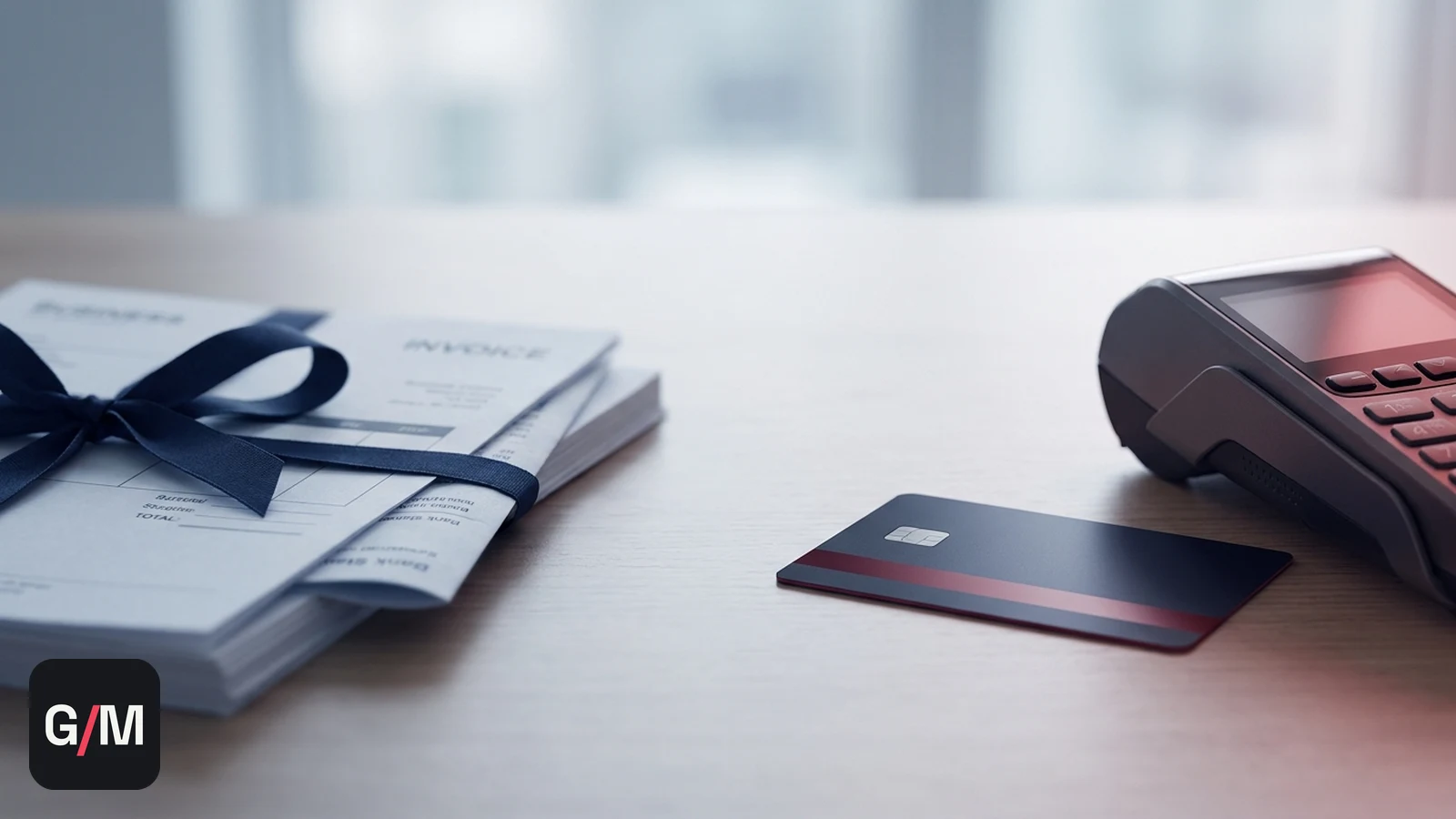
- Cards are priced as a percentage of the sale while ACH is typically a flat per-item fee, so the cheaper rail depends almost entirely on your average ticket size.
- The ACH Network moved 35.2 billion payments worth $93 trillion in 2025, and ACH now accounts for nearly three-quarters of US noncash payment value while cards lead by transaction count.
- Dispute exposure differs sharply: card disputes generally run around 120 days, consumer ACH debits carry an extended unauthorized-return window, and corporate ACH debits typically must be returned within a few banking days.
- Nacha enforces its own return rate levels (0.5% unauthorized, 3.0% administrative, 15.0% overall), which are stricter than many merchants expect coming from card processing.
- B2B checks fell from 75% of B2B payments in 2004 to 26% in 2025, and that volume is largely moving to ACH rather than cards, because nobody wants to pay a percentage on a six-figure invoice.
The practical difference between ACH and card payments comes down to two things: how you get charged, and how long you stay exposed to a reversal. ACH moves money bank account to bank account, typically for a flat fee per payment. Cards route through the card networks and cost a percentage of the sale. That pricing structure alone decides which rail is cheaper for your business, and it has nothing to do with which one is "better."
How Each Rail Actually Moves Money
An ACH payment goes directly between bank accounts through the ACH Network, operated under rules set by Nacha. There's no card, no interchange, and no card network in the middle. A card payment routes from your terminal or gateway through a processor to the card network to the customer's issuing bank, and back.
The scale of both is enormous. The ACH Network moved 35.2 billion payments worth $93 trillion in 2025, with volume up nearly 5% and value up almost 8% over the prior year (Nacha, 2026). Cards dominate on a different axis: the Federal Reserve's 2025 payments study found cards account for over three-quarters of noncash payments by number, while ACH accounts for nearly three-quarters of noncash payment value (Federal Reserve, 2026).
That split is the whole story in one sentence. Cards win on transaction count. ACH wins on dollars moved. Small payments run on cards, large payments run on ACH.
The Cost Difference Is Structural, Not Just Cheaper
Here's the part that actually matters for your margin. Card processing is priced as a percentage of the transaction plus a small fixed fee, so the cost scales directly with ticket size. A $10,000 sale costs roughly ten times what a $1,000 sale costs. ACH is typically priced as a flat per-item fee, so a $10,000 payment and a $100 payment often cost close to the same to process.
That means the answer to "which is cheaper" depends entirely on your average ticket. At low ticket sizes, card pricing is competitive and the convenience usually wins. As average ticket climbs into the thousands, the percentage-based card cost grows without limit while the flat ACH fee doesn't move. For a B2B business invoicing $15,000 at a time, that gap gets large fast.
Worth being straight about: exact ACH pricing varies by bank and processor, and there's no authoritative published rate the way there is for card interchange. Visa publishes its interchange schedule, but ACH pricing is negotiated per relationship. Ask for the actual per-item number in writing rather than assuming a standard rate exists.
The Dispute Window Difference Almost Nobody Explains
This is the most useful thing on this page, and it's genuinely under-covered. The window during which a payment can come back at you differs enormously by rail and by who paid you.
Cards: a cardholder generally has around 120 days from the transaction to dispute it, and certain deferred-delivery scenarios extend far longer. That's a long tail of exposure on every sale.
ACH from a consumer: Regulation E gives consumers real protection. A consumer must report an unauthorized electronic fund transfer appearing on a periodic statement within 60 days of the statement being sent, with liability tiers capped at $50 or $500 depending on how quickly they report (eCFR, 12 CFR 1005.6). Practically, consumer ACH debits carry an extended unauthorized-return window measured in weeks, not days.
ACH from another business: corporate ACH debits carry a dramatically shorter return window than consumer debits, measured in a small number of banking days rather than months. Confirm the exact count with your ODFI, since it's set by the Nacha Operating Rules rather than published on a public page.
So for a B2B business collecting from other businesses, ACH exposure closes in days while card exposure stays open for months. That's a real risk-management argument for ACH on B2B rails, and it's separate from the cost argument entirely.
ACH Has Its Own Monitoring Program (And It's Strict)
If you're used to card chargeback ratios, ACH has a direct parallel that catches businesses off guard. Nacha enforces return rate levels on originators, and they're tighter than most people expect (Nacha):
- Unauthorized return rate: 0.5% (return codes R05, R07, R10, R29, R51)
- Administrative return rate: 3.0% (codes R02, R03, R04, covering account data errors)
- Overall return rate: 15.0% (all debit returns for any reason)
Crossing a level doesn't automatically mean a rules violation. It triggers a preliminary inquiry into your origination practices, which can close with no action. But that 0.5% unauthorized threshold is meaningfully stricter than the card-network dispute ratios most merchants track, and a business moving to ACH assuming it's a softer regime is in for a surprise.
Settlement Speed
Standard ACH settles in one to two business days. Same Day ACH exists and has scaled substantially, with 1.4 billion Same Day ACH payments worth $3.9 trillion in 2025 (Nacha, 2026). Card settlement is typically next business day, sometimes same day depending on your account's funding terms.
For most businesses these are close enough that settlement speed isn't the deciding factor. Cost structure and dispute exposure are.
Where B2B Payments Are Actually Heading
The direction of travel is clear. B2B check payments have collapsed from 75% of B2B payments in 2004 to just 26% in 2025, a new low (Nacha, citing the AFP Digital Payments Survey, 2025). Meanwhile B2B volume on the ACH Network grew almost 10% in 2025 alone, reaching close to 8.1 billion payments (Nacha, 2026).
Those businesses leaving checks are mostly landing on ACH, not cards, and the reason is the cost structure described above. Nobody wants to pay a percentage on a six-figure invoice.
Which One Should You Actually Use?
Honestly, most businesses should support both, but weight them differently:
- Low average ticket, consumer-facing, one-time purchases: cards. The convenience and conversion advantage outweighs the percentage cost, and customers expect it.
- High average ticket, B2B, invoiced payments: ACH processing. Flat pricing on large amounts, and a much shorter dispute window from business payers.
- Recurring billing and subscriptions: often both. Cards for consumer subscriptions where card-on-file is expected, ACH for higher-value B2B retainers where the percentage would bite.
- High-risk merchants specifically: running both rails is a resilience play, not just a cost one. If a card MID gets reviewed or frozen, an ACH rail keeps revenue moving. That's the same logic behind a multi-MID structure, applied across payment types.
Frequently Asked Questions
Is ACH always cheaper than card processing?
No. ACH is usually cheaper at higher ticket sizes because it's priced as a flat per-item fee rather than a percentage. At small ticket sizes the difference narrows and card convenience often wins.
Can an ACH payment be reversed like a chargeback?
Yes, through an ACH return, but the windows differ significantly. Consumer ACH debits carry an extended unauthorized-return window, while corporate ACH debits typically must be returned within a small number of banking days.
Does ACH have chargeback ratio limits like cards do?
Yes. Nacha enforces return rate levels, including a 0.5% unauthorized return rate, a 3.0% administrative return rate, and a 15.0% overall return rate. Crossing one triggers an inquiry into your origination practices.
Do I need a separate account to accept ACH?
Usually yes, ACH origination is set up separately from card processing, though many providers offer both under one relationship. The underwriting is also separate, since the risk profiles differ.
Is ACH available for international payments?
No. The ACH Network is domestic to the US. Cross-border payments run on different rails, which is worth planning around if you sell internationally.
Which rail is better for recurring billing?
It depends on your customer. Consumer subscriptions usually run better on cards because customers expect card-on-file. Higher-value B2B retainers often run better on ACH, where the flat fee saves real money on every cycle.
Running high-ticket or B2B invoicing and paying card rates on all of it? Apply free for a 24 to 48 hour decision, or talk to a specialist about adding ACH alongside your card processing.
Gray Merchants Team
Gray Merchants is a payment ISO that places merchant accounts across every risk level, from low-risk retail and e-commerce to 67+ high-risk verticals. The editorial team writes on high-risk merchant accounts, chargeback defense, MATCH/TMF remediation, and ACH processing, whether you are new, scaling, switching processors, or rebuilding after a decline.